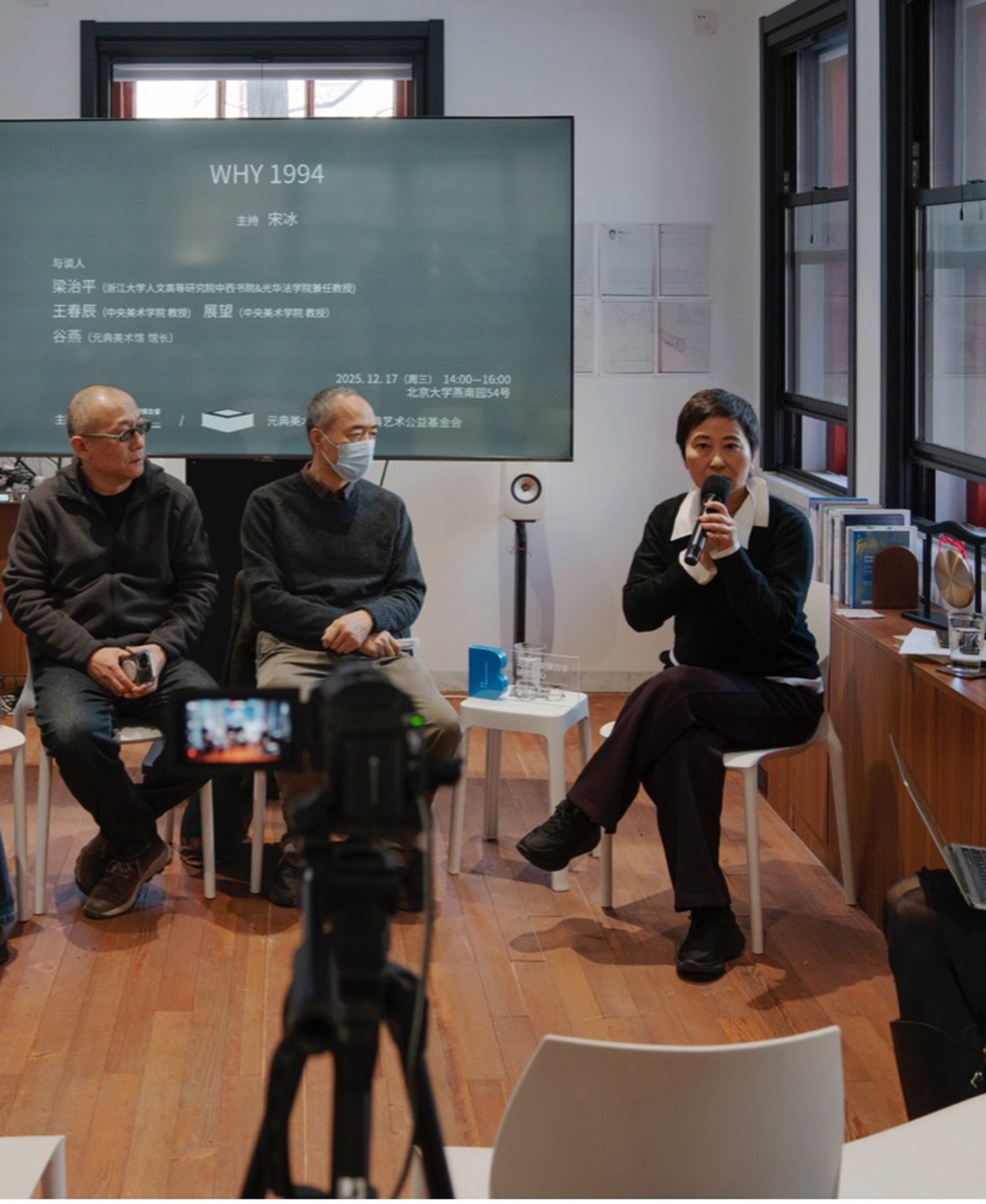
Why 1994? “The Modernity of Anti-Modernity” and Rethinking China Studies
- Date: May 25, 2026
- Location: No. 54 Yannan Garden, Peking University
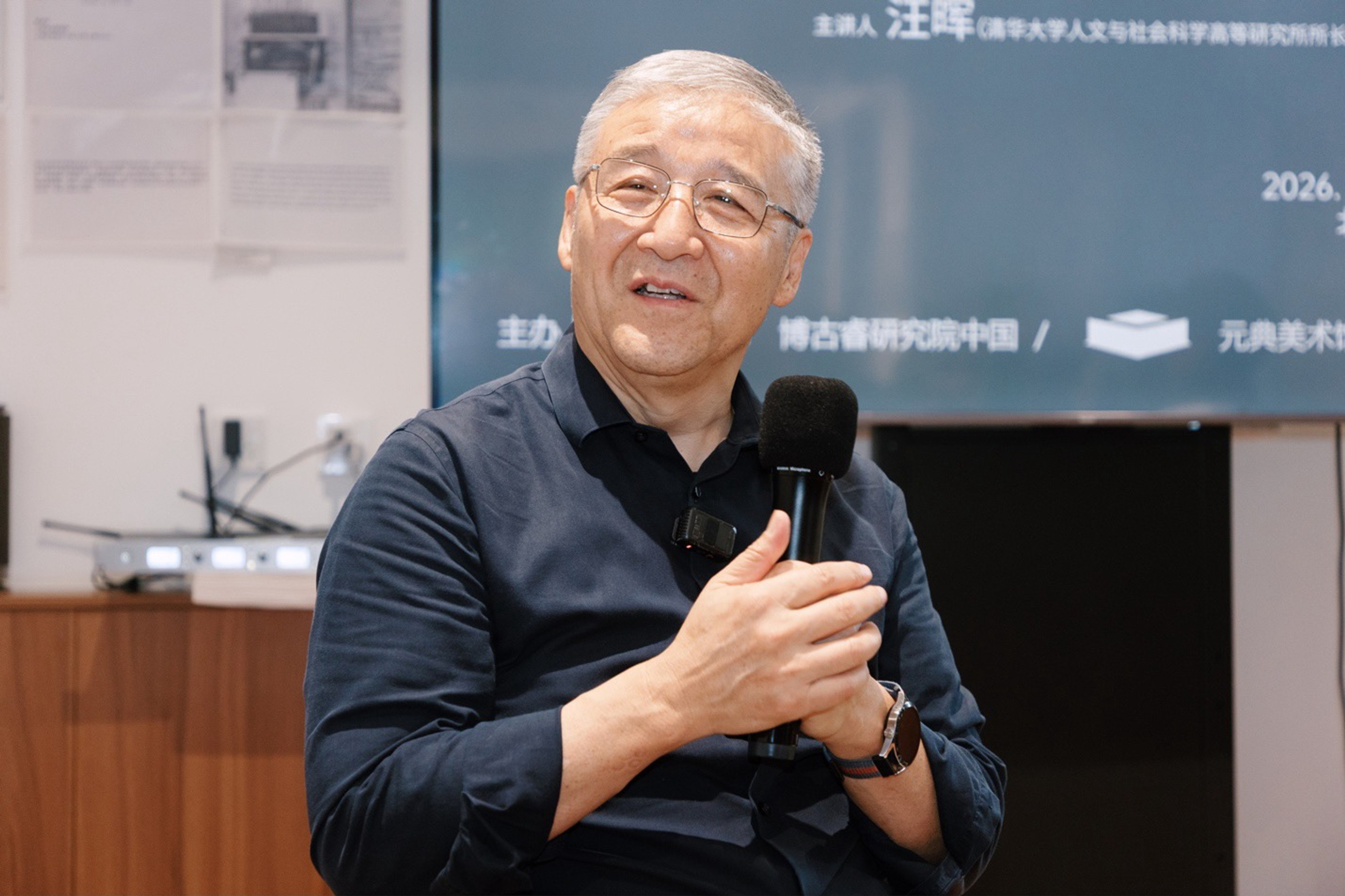
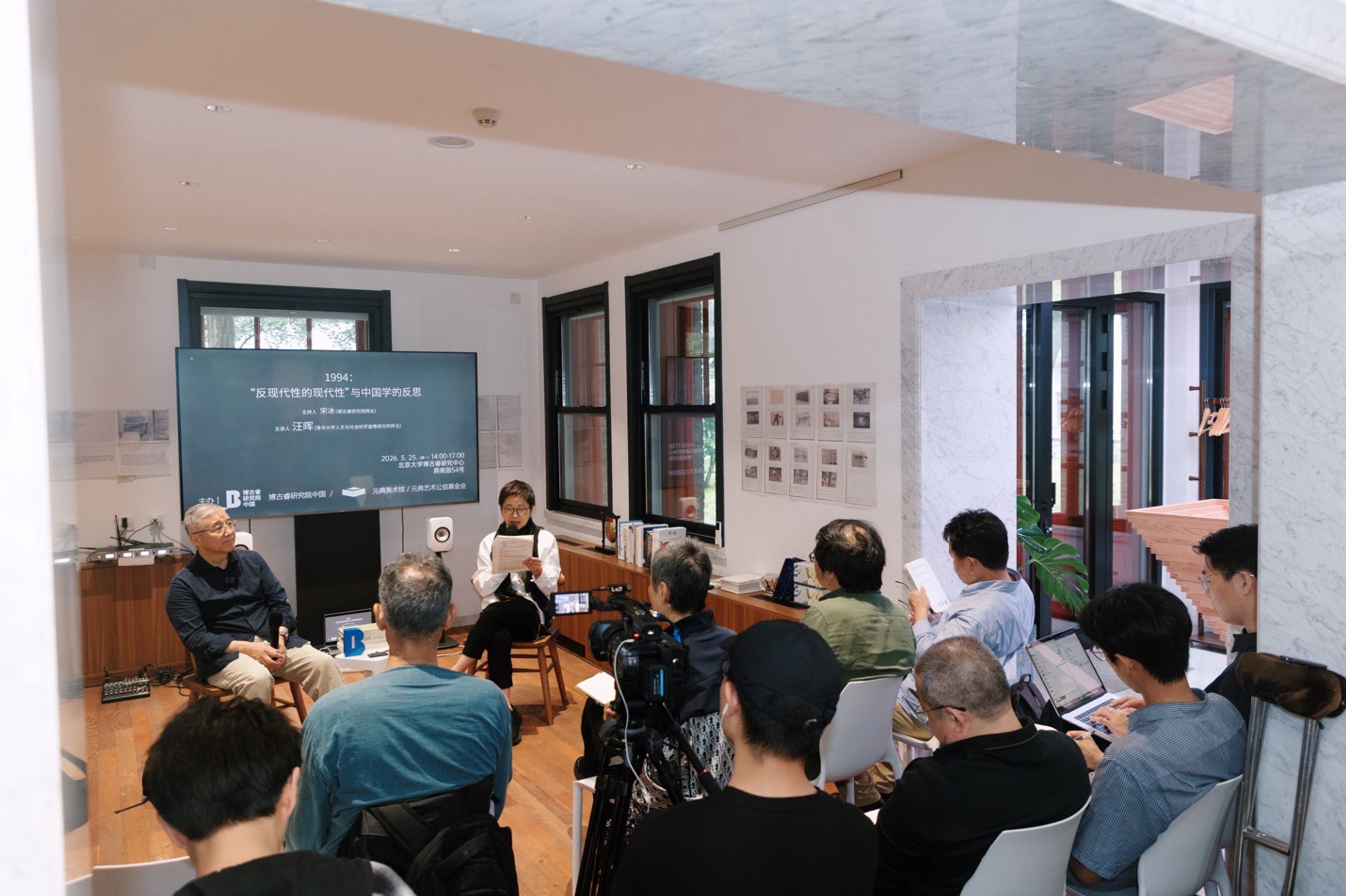
On May 25, 2026, the Berggruen Research Center at Peking University hosted a lecture entitled “The Modernity of Anti-Modernity and Rethinking China Studies,” delivered by Wang Hui, Director of the Institute for Advanced Study in Humanities and Social Sciences at Tsinghua University. The event was moderated by Bing Song, President of the Berggruen Institute.
Using the ongoing Why 1994? exhibition as his point of departure, Wang moved beyond retrospective commemoration or cultural nostalgia. Instead, he revisited a profound shift in Chinese intellectual inquiry that emerged in the mid-1990s: the moment when Chinese intellectuals ceased to see modernityas a self-evident historical destination and instead began to take it as an object requiring historical, theoretical, and critical examination—just as they felt that we could no longer understand China Studies merely as the accumulation of knowledge about China, but rather as a point of departure for rethinking the modern world itself.
What is the “Modernity of Anti-Modernity”
The lecture’s central intervention lay in transforming “1994” from a turning point in intellectual methodology. Its significance does not derive from the calendar year itself, but from what it has come to represent in retrospect. It marks the point at which Chinese intellectuals, after the Enlightenment-oriented discourse of the 1980s, began to reconsider the relationships among modernity, revolution, the social sciences, and the Chinese experience.
The early 1990s saw the end of the Cold War, the global expansion of capitalism, and the restructuring of dominant knowledge paradigms. Western intellectual life remained vibrant, with Habermas, Rawls, Foucault, Derrida, and postcolonial theory shaping diverse theoretical currents. Yet whether these frameworks could adequately explain global transformations—and particularly China's ongoing social transformation—had become an open question. It was within this atmosphere of uncertainty and intellectual reorientation that the essays and dialogues produced around 1994 gave rise to a new set of theoretical concerns.
Whereas Chinese intellectual discourse in the 1980s was largely framed by the project of overcoming “feudalism, ”interpreting political, social, and cultural problems as survivals of tradition or deficiencies in modernization, Wang argued that the more urgent question was not how China could become modern, but how modernity itself had been historically constructed, universalized, and naturalized—and where its internal contradictions, abstractions, and forms of violence became visible.
To develop this argument, Wang revisited a series of texts written or completed around 1994, including his study of Zhang Taiyan in “The Origins of the Idea of the Individual and Modern Chinese Identity;” successive versions of “Contemporary Chinese Thought and the Question of Modernity;” and his dialogue with Mizoguchi Yūzō on the problem of “China Studies without China.”
Rather than representing a discrete phase in an individual scholar’s career, these writings collectively marked the emergence of a new intellectual orientation. Together they explored anti-modern currents within contemporary Chinese thought, questioned the epistemological foundations of the modern social sciences, analyzed structural divisions within Chinese intellectual life during the 1990s, and examined the limits of China Studies as a mode of knowledge production. Their shared ambition was to transform China from an object of explanation into a site of theoretical production: rather than asking how China might fit existing narratives of modernity, they asked how the Chinese experience might compelus to rethink the assumptions and limits of modernity, the social sciences, and China Studies themselves.
Wang’s study of Zhang Taiyan opened the deepest intellectual genealogy of what he calls “the modernity of anti-modernity.” A turn-of-the-century philologist and philosopher, Zhang cannot be neatly categorized within binaries such as tradition versus modernity, conservatism versus progress, or empire versus nation-state. Despite living through the collapse of the Qing Empire, the rise of nationalist revolution, and the formation of the modern state, Zhang remained deeply skeptical of evolutionary theory, statism, civilizational hierarchies, and linear conceptions of history. His thought reveals the paradoxical structure of modern Chinese intellectual history: it participated in modern revolution while simultaneously criticizing modern civilization; it confronted the construction of nation and state while questioning the forms of domination produced through the abstraction of the modern state. Here, anti-modernity is neither a remnant of the premodern past nor a nostalgic return to tradition, but a critical force generated from within modernity itself.
From this perspective, modern Chinese thought should not be understood as a linear transition from tradition to modernity, but as a continuous process of resisting, redirecting, and reconfiguring modernity from within.
Wang then turned to Max Weber and the question of Chinese modernity, extending Weber’s critique of Chinese governance to the epistemological foundations of the social sciences. Rather than asking how Weber might explain China, Wang reversed the question: How have the conceptual frameworks of modern social science shaped the very ways in which China has been understood?
Since the 1980s, modernization theory had become a dominant framework for interpreting Chinese history, organized around categories such as tradition and modernity, rationality and irrationality, feudalism and enlightenment. Yet this framework often reduced Weber to a simple precursor of modernization theory, overlooking his profound skepticism of the modern world. By rereading Weber, Wang sought to recover the complexity of Weber’s thought while demonstrating that placing China perpetually in the position of “not yet modernized” obscures the histories of capitalism, imperialism, and colonialism, as well as the contradictions internal to modernity itself. In this way, Chinese modernity constitutes a challenge to modernization theory itself.
His essay “Contemporary Chinese Thought and the Question of Modernity” directly addressed the changing intellectual landscape of the 1990s. Debates surrounding the “humanistic spirit,” analytical Marxism, institutional innovation, and conservatism, along with novel reassessments of the May Fourth Movement, radicalism, and twentieth-century Chinese revolution collectively transformed the intellectual field. Although the various positions taken in these debates often diverged sharply, they all disrupted the Enlightenment-centered narrative that had dominated the previous decade. The central question shifted from why China had failed to become an ideal modern society toward how China’s revolutionary experience, socialist practice, mass politics, national liberation, and state-building should be understood on their own terms.
Wang’s intervention proved especially significant here. He rejected interpretations that reduced twentieth-century China either to a failed history of escalating radicalism or to a simple restoration of traditional political forms through socialism. Instead, he sought to confront the deeper paradoxes of modern Chinese history: its simultaneous opposition to capitalism and feudalism, and simultaneous commitment to development and to criticism of developmentalism itself.
It is precisely here that “the modernity of anti-modernity” acquires its analytical force. Rather than a rhetorical paradox, it offers a historical characterization of non-Western modernity. In Western contexts, anti-modernity often appears as aesthetic modernism, cultural critique, or intellectual anti-capitalism. In China and other non-Western societies, however, anti-modernity extends beyond ideology into economic structures, social organization, and political practice. Societies seeking to overcome colonial domination often had to develop modern productive forces, build modern states, and enter the global system. Yet following the capitalist path of modernization risked reproducing new forms of domination and inequality. Consequently, they were compelled simultaneously to pursue modernity and to negate its capitalist form. This structure of self-negation, contradiction, and self-transformation forms the historical logic that Wang sought to illuminate.
“China Studies Without China” and the “Internal Perspective”
The lecture’s discussion of China Studies extended these questions from intellectual history to the politics of knowledge production. The phrase “China Studies without China” was not a rejection of overseas scholarship on China, nor an appeal to cultural essentialism. Rather, it criticized a more pervasive epistemological structure in which China consistently appears as an object to be explained, classified, and fitted into preexisting theoretical frameworks, while rarely serving as a site where theoretical problems themselves emerge.
China may possess abundant archives, historical experience, and empirical materials, yet it still fails to enter the realm of conceptual production. And whether it be labeled an empire, a nation-state, a traditional society, a late modernizer, or a civilization-state, it remains confined within externally imposed categories. The crisis of China Studies, Wang argued, lies precisely here: that there is abundant knowledge about China, but no genuine theoretical problems generated by China.
Accordingly, an “internal perspective” does not mean isolating China from the world or rejecting universal theory in the name of Chinese exceptionalism. Rather, it challenges explanatory approaches that begin with supposedly universal categories—such as empire, nation-state, individual, or society—and subsequently apply them to the Chinese experience. Wang instead proposed releasing the object of study from these predetermined conceptual positions, allowing concepts and historical processes to reshape one another dynamically.
Importantly, these categories are themselves historical products rather than neutral analytical tools. As they entered Chinese history, they underwent processes of translation, appropriation, resistance, transformation, and reinvention, acquiring new meanings through China’s revolutionary experience, state formation, social transformation, and engagement with the world.
In this sense, the task of China Studies is not merely to explain China through established concepts, but to ask how these concepts themselves are displaced through the Chinese experience—and how Chinese history exposes the assumptions and limitations of modern social science. Genuine reflection on China Studies thus transforms China from a research object into a theoretical event.
Wang illustrated this methodological intervention through a critique of the binary opposition between empire and nation-state. Although Chinese history undoubtedly encompasses imperial formations, and modern China has indeed undergone nation-state construction, reducing China either to a premodern empire or to the linear completion of the nation-state obscures the complexity of its political formation. Neither the state nor the nation can be understood apart from social structures, modes of production, frontier relations, international orders, and revolutionary practice. Modern China emerged through the simultaneous transformation of imperial legacies, struggles for sovereignty under colonial pressure, national liberation movements, socialist internationalism, popular politics, and state-building. Simplistic binaries such as empire versus nation-state or tradition versus modernity therefore conceal the historical dynamics they seek to explain.
When We Talk About China Today
The lecture concluded by returning once more to the significance of 1994. Looking back to this moment was not an act of intellectual commemoration but an effort to understand how new theoretical questions emerge precisely when inherited explanatory frameworks begin to dissolve. Around 1994, Chinese intellectual life gradually moved beyond the relatively unified Enlightenment-modernization narrative of the 1980s and began to ask new questions concerning the historical conditions of modernity, the epistemological foundations of the social sciences, the complex legacy of twentieth-century revolution, and the possibility that the Chinese experience might generate new theoretical vocabularies.
These questions remain strikingly relevant today. The promises of globalization have fractured, technological transformation is reshaping the foundations of society, economy, and culture, and discussions of China are once again dominated by geopolitical rivalry, institutional competition, civilizational conflict, and nation-state narratives. Returning to 1994 is therefore not a reactive return to the past but a reactivation of an unfinished intellectual agenda: How should we understand the crises internal to modernity? How can China be understood without reducing it to a belated modernizer, an exception to the global order, or merely an object of strategic competition? And how might China Studies move beyond explaining China to participate in reconstructing the conceptual language through which we understand the modern world?
This, ultimately, was the lecture’s deepest intellectual contribution. It refused to treat modernity as a single direction, a single measure, or a single answer, just as it refused to assign the Chinese experience a predetermined place within external theoretical frameworks. The significance of modern Chinese thought lies precisely in its enduring engagement with paradox: it seeks emancipation while confronting the necessity of statehood, resists imperialism while grappling with nationhood and sovereignty, criticizes capitalism while addressing development and productive forces, and inherits the revolutionary legacy of the twentieth century while reassessing its historical costs.
The enduring importance of 1994 lies in its return of these unresolved questions to the center of intellectual inquiry. It reminds us that if historical research is to remain a living form of thought, it cannot simply classify the past; it must revisit the contradictions that remain unresolved in order to illuminate the present and open new possibilities for the future.
--
Drafted by Berggruen Intern Lochlan Zhang
Edited by Xiaojiao Li, Chang Zhang
English proofread by Berggruen Intern Jonah Dunch
About The Berggruen Institute
About The Berggruen Institute
About The Berggruen Institute
About The Berggruen Institute
About The Berggruen Institute
About The Berggruen Institute
About The Berggruen Institute
About The Berggruen Institute
About The Berggruen Institute
About The Berggruen Institute
Related