The Humility Of Bioscientists
Noema Weekly Roundup | April 25, 2026
---
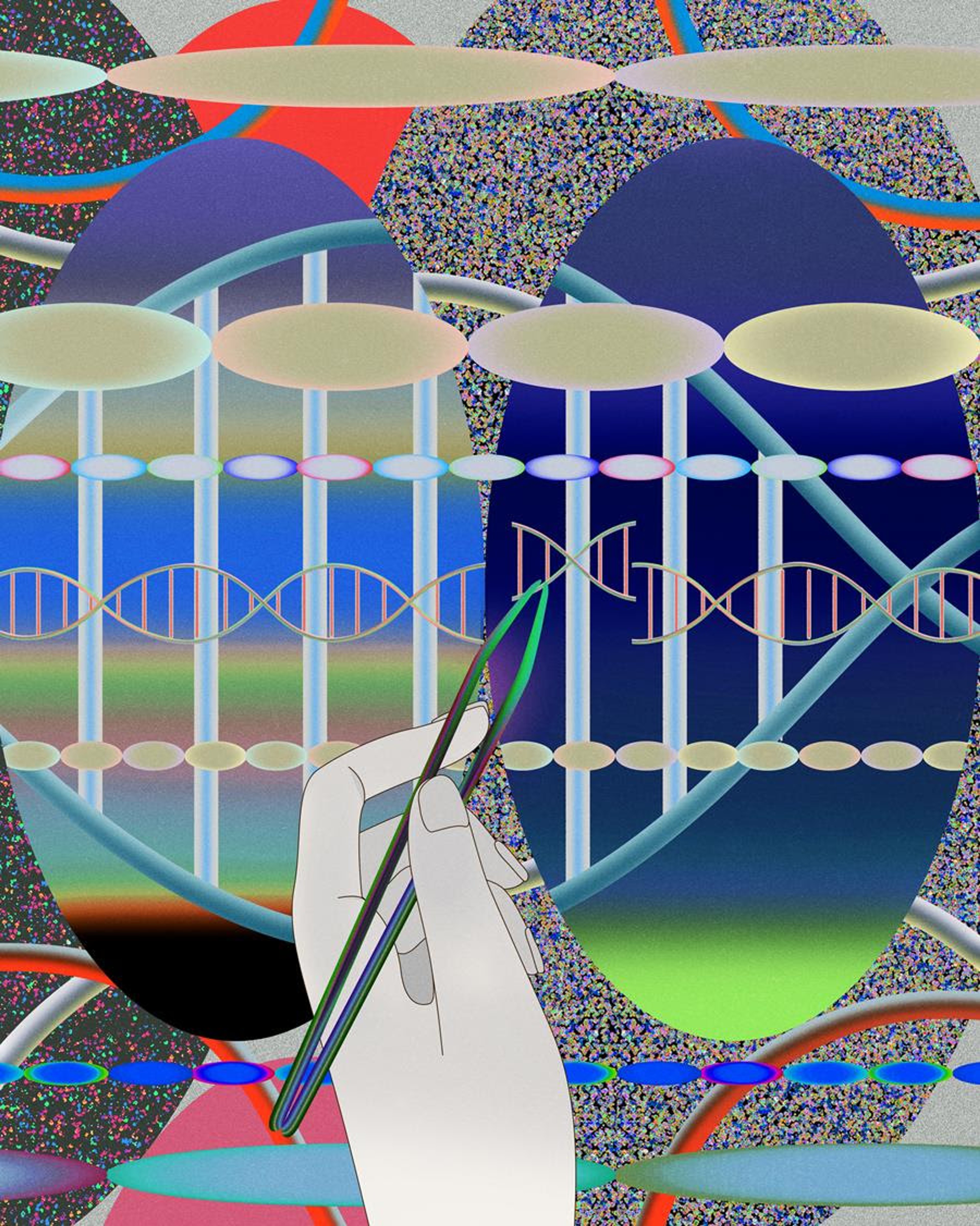
The two epoch-shifting technologies transforming the human condition as we’ve known it are artificial intelligence and gene editing.
Unlike the hyper-scaling accelerationists of AI, researchers at the frontier of the biosciences tend to harbor an admirable humility and sense of precaution. Wary of tampering with life in ignorance, those most in the know are fully aware of what little they know about the complexities of biology.
This is strikingly evident in discussions that Noema Magazine and the Berggruen Institute’s Futurology podcast have held with the leading bioscientists Jennifer Doudna and Craig Venter. Doudna was awarded the Nobel Prize in 2020, along with Emmanuelle Charpentier, for “the development of a method of genome editing with CRISPR.” Venter is the pioneering cartographer of the human genome. He has also been the first to successfully construct a synthetic bacterial cell.
The Gene Editing Revolution
As Doudna explains on Futurology, “We know that DNA is the genetic code. It’s the code of life. It’s also an inert molecule. It’s capable of storing genetic information over a long period of time. It’s stable.
“Proteins are active molecules. They function in many ways in cells, but one of the important functions is to copy DNA. So they’re the engine that’s actually copying the genetic code.
“RNA is the intermediary. You could think of it as a temporary copy of little snippets of DNA. It’s transient. It forms the little messages that tell cells what to do and which proteins to make.”
These functions are the molecular basis of our adaptive immune system, which both remembers viral visitations of the past to block them when they return as well as proactively fights new arrivals.
With this understanding, Doudna and her colleague devised a tool that leverages the natural immune system’s adaptive response by reprogramming it to edit targeted DNA sequences, cutting them out or altering them with what amounts to “molecular scissors.”
This so-called CRISPR-Cas9 method has already enabled the treatment of genetic disorders such as sickle cell anemia and can be customized to correct other genetic mutations. New methods of delivery, such as direct injection into stem cells or the insertion of “lipid nanoparticles” into the liver, promise to enhance scalability for human health.
As Doudna fascinatingly notes, basic research using their tool has opened new pathways to understanding genetics by observing how the color pattern of butterfly wings or the curvature of seashells can be altered.
There are other near-term advances beyond human health. “We’re going to see a bigger global impact sooner with agricultural applications of CRISPR because it’s easier, in a way, to do the kinds of manipulations in plants that might have really beneficial impacts going forward, especially as we deal with challenges of growing population and climate change.” What she has in mind, for example, is the genetic design of drought-resistant crops as the Earth grows more arid. Rice, cacao and bananas are all being experimented with today.
One of the prevalent greenhouse gases is methane, released from cattle. CRISPR is a technology that could be used to fine-tune the metabolic process that produces methane gas in the cow’s digestive system. “We could do it by applying CRISPR directly in cattle, maybe through a pill or something that you could feed to them in their diet, maybe do it once, in a way that would alter the microbiome over their entire lifetime.”
“It’s a lot easier for me to see the scalability of that type of an approach than when we talk about treating rare diseases or even other kinds of human disease, where there’s still, frankly, a lot of work to be done on safety to ensure that the procedures are working as intended.”
The Ethical Challenge
The greatest ethical challenge of her invention, as Doudna sees it, is that immediately after the announcement of their discovery, “many people started thinking about the opportunities to not only understand fundamentals of human genetics in a new way using this kind of technology, but frankly, to also rewrite the genetic code in a precise way.”
What alarmed Doudna was an article published in the scientific journal Cell about making CRISPR edits in monkey embryos, which were then transplanted into a mother monkey, leading to the birth of CRISPR-edited baby monkeys.
She remembers thinking, “I don’t see any reason technically why you couldn’t edit embryo DNA, but no one had done it at the time. And I thought, are people really going to go there? And the answer was yes, they are.”
My colleagues and I realized, she says, “lines are already being crossed.”
After gatherings with other scientists, including at workshops of the National Academies of Sciences, Engineering and Medicine in the U.S. and other countries, “we arrived at a global sense among scientists that we need to work together to ensure responsible use of CRISPR,” Doudna said.
“And there’s no obvious way to do that. We have to encourage transparency when you have powerful technologies that are developing in a way faster than regulators can keep up.”
Doudna’s main concern is “germline editing” — changes to the genome that are then inherited going forward.
Her concern not only involves such changes in humans, but also “applications in the environment where there could be risks of spreading a genetically altered insect, for example. Or making an insect population vulnerable to certain drugs or to sterilization that could be seen as beneficial, but it also could have unintended environmental impacts.”
These apparent risks, she argues, mean “we at least need to develop a framework that scientists would respect and would create a culture of responsible use of CRISPR. I think that there is a kind of an international feeling that we’re all part of a community, that science doesn’t have boundaries. And that we need to be working together to ensure that scientific research is having positive benefit on our societies and on the planet.”
Doudna acknowledges that not everyone shares this view, “but I think the majority do.” So far, she believes governments have been acting responsibly.
Just about a decade ago, “a Chinese scientist edited human embryos and used them clinically to create a pregnancy. That led to a very rapid response on the part of the Chinese government.
“They shut down the scientist’s lab, they cancelled his funding, they put him in jail. That really made it clear that this was not acceptable and that others shouldn’t proceed in his footsteps.”
The Limits Of Knowledge
For Doudna, “the biggest challenge is knowledge. We don’t know which genes to tweak for any kind of trait. It’s not going to be one gene. It’s going to be pretty complicated. And it may even be a different cohort of genes for each one of us, depending on our specific genetic background.”
That knowledge may come over time, “but it’s going to take time and effort to figure out enough about human genetics that we could make those kinds of tweaks. Could such a thing happen? Sure, I think it could. And so, again, I’ve been an advocate for discussing this kind of thing openly and transparently. I think we have to get ready for the time when such potential enhancements are possible.
“This intersects with the whole area of germline editing — the idea that you could make heritable changes.”
She continues: “All of the applications so far are being done in individuals. But they’re not making heritable changes that are passed on to future generations. If you have a somatic mutation or a somatic application of CRISPR, then it means that you are affecting an individual, but you’re not affecting anything about their germline.
“You’re not changing the genetics of their children in the future. A use of CRISPR like that is, in a way, not different from any other kind of therapeutic that you might use in an individual. It comes with risk, but it’s risk to that person. It’s not a risk to future generations.
“Germline editing is different, though. Germline editing means making changes in eggs or sperm or embryos that are then inheritable by future generations. It’s a much more fundamental kind of application of CRISPR. And this is what happened with the children in China, the twins in China who were edited back in 2018. That was a heritable change that was made.”
Some people, she continued, feel that, ‘If I have a genetic disease in my family and every generation is going to have to deal with this … maybe I could go through IVF every time and do embryo selection. What if I could just make a one-time correction to that gene and never have to worry about it in the future? Wouldn’t that be better?’
“There could be an argument for that. But the safety of the technology would have to be there. But we are not there yet. We don’t really understand how it works in embryos very well. And I don’t think that we could guarantee the safety at a level that would justify the risk.
“I think we’re wrong to think we understand a lot about biology. What I’ve learned, if I’ve learned anything as a biologist over the decades, is that the more we learn, the more we realize there is to know.
“And it’s so true in genetics. When the sequence of the human genome was reported back around the year 2000, there was a feeling across the field that we were sort of on the downhill slope now of really being able to control biology; to understand the contents of the genome and manipulate it. And here we are 25-plus years later, and I think we realize just how not true that is.”
This lesson, of just how much we don’t know, is also the view of Venter, who was one of the key scientists mapping the human genome over two decades ago.
“For all the hype, we’re still at an early stage of interpreting the human genome,” he told Noema. “I said 20 years ago that we know less than 1% about the functioning of all the genes in the genome. And I don’t think we’ve seen much progress in this respect since.
“Yes, we’ve seen a lot of progress in mapping and processing genomes. But we just still do not have sufficient knowledge and understanding of the genome to assuredly go in and make changes that do not cause more harm than good. We just still don’t understand our own biology very well.”
By way of example, Venter argued, “Some people treat manic depression as a disease that has genetic causes. It would be great to get rid of it. But the argument has been made that the most creative people also fall somewhere along the spectrum of manic depression. So will we eliminate all those great leaps of creativity from the human population if we manage to eliminate the depression gene?”
With respect to CRISPR editing, he says, “It is a great tool for advancing research, but it is not a magic tool. You can make specific changes in genes with it, but it has what’s called ‘off-target effects’ that cause random changes in other genes. So if you think you’re correcting Tay-Sachs disease, without measuring every other change in the genome that you’re making and understanding its effects, you could be causing far more harm than good.
“We get caught up in the science fiction of ‘now that we have these magic tools, we can rewrite the human genetic code.’ We are decades, if not centuries, away from having enough knowledge to be able to do that intelligently and responsibly.
“We have a very substantial amount of biology left to learn, even though everybody was getting to the point where they thought we knew it all. As soon as you start to think that, you’re wrong.”
Containing Unleashed Power
As one of the more reflective technologists coming from the digital perspective, Microsoft AI CEO Mustafa Suleyman offers this framework for thinking about responsibility at the technological frontier, including in the biosciences. “For the first time, core components of our technological ecosystem directly address two foundational properties of our world: intelligence and life. In other words, technology is undergoing a phase transition. No longer simply a tool, it’s going to engineer life and rival — and surpass — our own intelligence,” he has written.
“For most of history,” he warns, “the challenge of technology lay in creating and unleashing its power. That has now flipped; the challenge of technology today is about containing its unleashed power, ensuring that it continues to serve us and our planet.”
---
Share your thoughts with us. Email: feedback@noemamag.com.
Illustration: Ibrahim Rayintakath for Noema Magazine
New in Noema
Emergence Is Not Engineering | Stuart Kauffman in conversation with Nathan Gardels
The universe creatively sets the rules for its own becoming.
The Rise And Fall Of ‘Petty Tyrants' by Danny Hillis
History shows that bad leaders can successfully undermine democracy — but the story always ends the same way.

PUBLISHER: Nicolas Berggruen
EDITORIAL BOARD: Orhan Pamuk, Pankaj Mishra, Dambisa Moyo, Rocio Martinez-Sampere, Patrick Soon-Shiong, Onora O’Neill, Elif Shafak, Reid Hoffman, Walter Isaacson, Arianna Huffington, Pico Iyer, Yoichi Funabashi, Fareed Zakaria, Helle Thorning-Schmidt, Kathleen Miles, Nathan Gardels, Bing Song
EDITORIAL TEAM: Nathan Gardels, Editor-in-Chief; Kathleen Miles, Executive Editor; Nils Gilman, Deputy Editor; Peter Mellgard, Deputy Editor; Tami Abdollah, Deputy Editor; Jesselyn Cook, Senior Editor; Jennifer Prohov, Content Strategist; Amara Higuera, Art Editor; JoAnna Klein, Fact-Checker; Mani Chandy, Newsletter Editor; Alex Gardels, Video Editor; Francis Wade, Commissioning Editor; Joe Zadeh, Contributing Writer; Carrie Arnold, Contributing Writer; Jennifer Bourne, Associate Editor & Translator; Claire Isabel Webb, Associate Editor; Jonathan Blake, Associate Editor
About The Berggruen Institute
About The Berggruen Institute
About The Berggruen Institute
About The Berggruen Institute
About The Berggruen Institute
About The Berggruen Institute
About The Berggruen Institute
About The Berggruen Institute
About The Berggruen Institute
About The Berggruen Institute
Related
Pope Leo: AI Wealth Must Be Universally Shared
There Is A Soul, But Not A Transcendent One
Virtual Civil Society Is Coming To China